Included
Everything needed for the promised setup
Two powered speakers, mixer, two wireless microphones, stands, standard signal and power cables, protective cases, and agreed backup items.
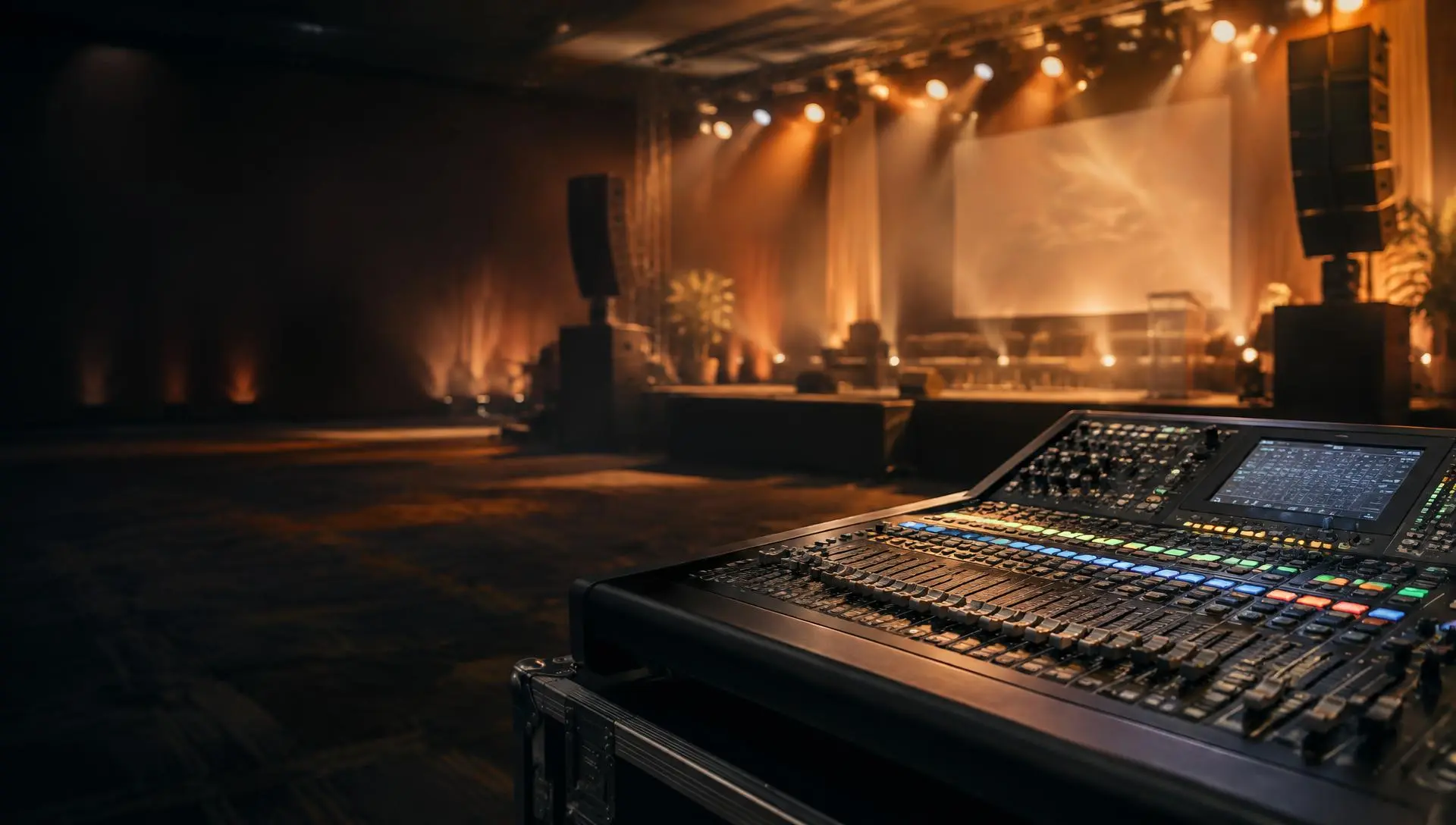
Set equipment rates that recover your costs, then price the preparation, delivery, crew, and support that turn those products into a working event.
A pair of speakers has a rental value. Clear speech in a meeting room, tested before the audience arrives, is a different service with different costs. AV pricing becomes much easier when you separate those two things.Start by deciding what the customer is buying. Then give every part of that service a place in the quote. Otherwise, preparation, problem-solving, and late-night collection quietly become work you provide for free.
Do not start with a percentage of the purchase price. Start with what the equipment costs to own, how much it may be worth when you sell it, and how many days customers will actually pay to use it.The example below is a complete speech package. Calculate at package level when the items normally go out together, but keep track of any shared items that can also be rented separately.
| Two powered speakers | $1,600 | |
| Compact mixer | $500 | |
| Two wireless microphone systems | $900 | |
| Stands, cables, and accessories | $400 | |
| Protective cases and essential spares | $300 | |
| Total | $3,700 |
Illustrative UK figures, excluding recoverable VAT. Use your own supplier prices and expected working life.
This covers the package's ownership cost only. General overhead, job labour, payment fees, and profit still need to come out of the selling rate.
If the package rents for $140 a day, $124.29 remains after that ownership-cost allowance. That is not your profit: it still contributes towards storage, insurance, administration, marketing, software, and the other costs of running the business.
There is no universal rule that AV equipment should rent for 5%, 10%, or any other fixed share of its purchase price. Product value matters, but so do reliability, expected life, demand, and the work required to make the product useful.
Check competitors only after you know your own floor. Compare like for like: a collection-only speaker rental, an installed speech system, and a staffed event are three different products. A lower public price may tell you very little about the service behind it.
A longer rental usually needs fewer handovers per rental day. That creates room for a lower effective daily equipment rate. Decide the reduction in advance, publish it where possible, and keep it separate from crew pricing.
State dispatch, use, and return times. Collection and return days are not automatically billable show days, but they can keep equipment out of circulation and should be reflected in your availability and pricing rules.
If equipment and crew are reserved for a rehearsal, venue hold, or standby day, include that commitment in the quote. No audience does not mean no cost.
A three-day equipment week does not make an eight-hour technician day cheaper. Charge for actual calls, show hours, travel, waiting, and overtime under the rules that apply where you work.
Illustrative duration pricing for the $140 speech package. These are example rules, not an industry-wide convention.
The event schedule shows when the doors open. Your quote needs to show everything required before and after that moment. Estimate each stage, apply a sustainable hourly or day rate, and record the actual time so the next quote improves.
A standard dry-hire order may need very little planning. A multi-room conference can need site visits, equipment drawings, frequency planning, source checks, supplier coordination, and several revisions. Include that work in the job or charge a defined design fee.
Testing a complete system, updating playback devices, charging batteries, checking adapters, packing cases, and preparing spares all take paid time. A package price should include a stated preparation allowance rather than assuming it happens between other jobs.
List call time, soundcheck or rehearsal, event operation, pack-down, and expected finish. State the minimum call where relevant, how overtime is approved, and what happens when the customer's schedule changes.
Counting cables, cleaning microphones, inspecting connectors, testing returns, and quarantining faults are part of the rental cycle. Allow for this work in your equipment economics or service labour, but do not count it twice.
Two venues five miles apart can create completely different jobs. One has a loading bay and a lift. The other has a restricted arrival window, paid parking, stairs, and a long carry through a public space. The mileage may be similar; the labour is not.
Set a minimum charge for delivered work if small orders cannot cover the trip. Keep the equipment price consistent and let the service lines reflect the venue. Moving the display upstairs does not make the display itself more valuable; it makes the job more expensive.
A speech package should include the stands, cables, connections, and basic spares needed to do its job. Turning every necessary cable into an add-on makes the headline price look lower and the final quote harder to trust.Use optional extras for changes that add real value or work: another microphone, a larger display, a second room, recording, or an operator. Build packages from shared stock so selling one package reserves the actual products inside it.
Two powered speakers, mixer, two wireless microphones, stands, standard signal and power cables, protective cases, and agreed backup items.
An additional wireless microphone for $35, a display for $90, or extra operator time at $40 an hour. These examples match the worked quote below.
| Speech package | Two speakers, mixer, two wireless microphones, stands, cables, and spares | $140 |
| Display | Display, rated stand, transport case, and standard connections | $90 |
| Warehouse preparation | 1 hour at $35: test, pack, and check the source connections | $35 |
| Delivery, setup, and collection | 5 hours at $35, plus a $45 vehicle charge | $220 |
| On-site technician | 8 hours at $40, including soundcheck and pack-down | $320 |
| Total | $805 |
A one-day company presentation, installed, operated, and collected as agreed. Illustrative prices, excluding VAT. The total is revenue before job costs and overhead, not profit.
The same customer could choose dry hire for $230, or delivered and installed without an operator for $485. Keep those service levels distinct. Otherwise, the customer reasonably expects the $230 price to include everything in the $805 version.
Cross-hiring lets you say yes to a larger display, a specialist microphone, or an extra speaker system without buying for one event. It also adds supplier costs, transport, compatibility checks, and another point of failure. Your price needs to cover all of that.
Confirm the supplier's stock before committing to your customer, and know who pays for transport, damage, cancellation, and a replacement if the supplier lets you down. If you cross-hire the same product repeatedly, compare the total supplier spend with the economics of buying your own.
AV equipment travels, connects to other devices, and is often handled under time pressure. Pricing needs a clear approach to loss, damage, consumables, and late returns. That approach must also match your insurance and legally reviewed rental terms.
Use an amount appropriate to the equipment and customer risk. A refundable deposit is not income, so do not include it when judging whether the rental price is profitable. Explain the release process and what deductions may be made.
If you offer a waiver or protection charge, state what it covers, the exclusions, and any customer excess. It is not automatically insurance. Check the structure with your insurer and adviser rather than copying another company's wording.
A late return can cause testing to be missed or the next booking to fail. Set a return deadline and a clear extra-charge rule that reflects the lost use and additional work. Contact the customer early rather than relying on a penalty to solve the problem.
Decide which batteries, tapes, and other single-use items are included and which are charged. List small accessories on the packing record too: a missing adapter or microphone clip can make the next handover incomplete.
The cheapest booking is not always the one with the lowest damage risk. Customer checks, a documented handover, secure transport, and suitable packing are part of protecting the margin.
Your list price is not the realised price. A $30 equipment discount and a waived $45 delivery charge turn the $805 example into $730 of revenue before costs. Record those changes instead of assuming the original quote survived to the invoice.Then compare revenue with the actual cost of the job: staff and freelance time, vehicle costs, outside suppliers, consumables, payment fees, and an equipment-cost allowance. Review general overhead separately and consistently so you do not count the same cost twice.
A standard speech package for collection should not need three emails to discover its price. Show the equipment price, what is included, the rental period, collection or delivery options, and any required deposit. Real-time availability lets the customer choose dates you can fulfil.Custom production is different. If the answer depends on the venue, technical design, rigging, crew, or outside suppliers, ask for a quote request with enough detail to price responsibly. Do not put a deceptively low “from” price online and then rebuild it for every real event.
Standard dry-hire products and clearly defined packages with predictable handover, duration, and availability. Optional extras can have fixed prices too.
Installed or staffed events, custom production, complex venues, multi-room systems, streaming, LED walls, and anything that needs technical planning.
With Booqable, standard products can share live inventory across online bookings and back-office quotes. That matters when the same speakers belong to several packages: the website should sell actual remaining stock, not the same system twice.
Pricing is a routine, not a launch task. Once a quarter, review each important product and service with your own bookings in front of you. Change one clear thing at a time and record what happens next.
Review paid rental days, realised revenue, maintenance, repair downtime, repeated sell-outs, and missed demand. Test a higher rate before buying more stock when the same items keep selling out.
Compare quoted and actual preparation, delivery, setup, operating, and return hours. Update labour rates when wages or freelance costs change, and revise access allowances that repeatedly prove too small.
Look for waived delivery, manual overrides, old customer rates, and recurring cross-hire costs. Fix the pricing rule behind a repeated exception rather than asking your team to negotiate it again on every quote.
If you are still shaping the offer, read how to start an AV rental business. For a broader method covering trailers, bikes, machinery, and other stock, see how to price your rental inventory.
Not by itself. A percentage can be a quick sense-check, but it ignores paid rental days, useful life, maintenance, resale value, compatibility work, and demand. Calculate the cost floor first, then compare your proposed rate with equivalent local offers. Two products with the same purchase price can need very different rates.
Charge for the equipment and people committed to those days. A rehearsal may need the same microphones, display, operator, and venue access as the event itself. Setup and collection can have different labour requirements from show days, so list them separately instead of hiding everything in a single event rate.
Set a weekly equipment rate based on your market and handling costs rather than multiplying the day rate by seven automatically. Some rental businesses use conventions such as a three-day week, but these are not universal. Define the included days, return deadline, extra-day charge, and any rehearsal or standby period. Do not apply the equipment discount to crew hours.
For dry hire, basic handover time can be built into the rental price. Preparation beyond that, delivery, installation, operation, rehearsals, waiting, and pack-down should be estimated and shown clearly. Separate lines make it easier to quote changes and compare what you planned with the hours the job actually took.
Start with the supplier's net price, then include collection or delivery, preparation, compatibility checks, insurance responsibilities, and your coordination time. Add a margin that reflects the work and risk you still carry. Confirm availability before promising the item, and do not treat the supplier's price as your final customer price.
No. A deposit is refundable security, not rental revenue. A damage waiver or protection charge is a separate commercial arrangement with stated cover and exclusions; it is not automatically an insurance policy. Ask your insurer and legal adviser what you may offer locally, and explain any customer excess or liability plainly.
Publish prices for standard equipment and clearly defined packages that customers can book without a technical discussion. Use quote requests for custom production, complex venues, multi-room events, LED walls, streaming, and work that depends on a site survey or crew availability. Online availability should draw from the same stock as your quotes.
Get full access for 14 days and see how easy managing rentals can be.